Guide
Entryway storage with hooks
A hook is the cheapest storage in the house and the one most often specified wrong. Two numbers decide whether yours work: what each hook holds, and how far off the floor it sits.
#ad — We earn a commission from qualifying purchases made through the Amazon links on this page, at no extra cost to you. It does not change what we recommend or the order we rank it in. Full disclosure.
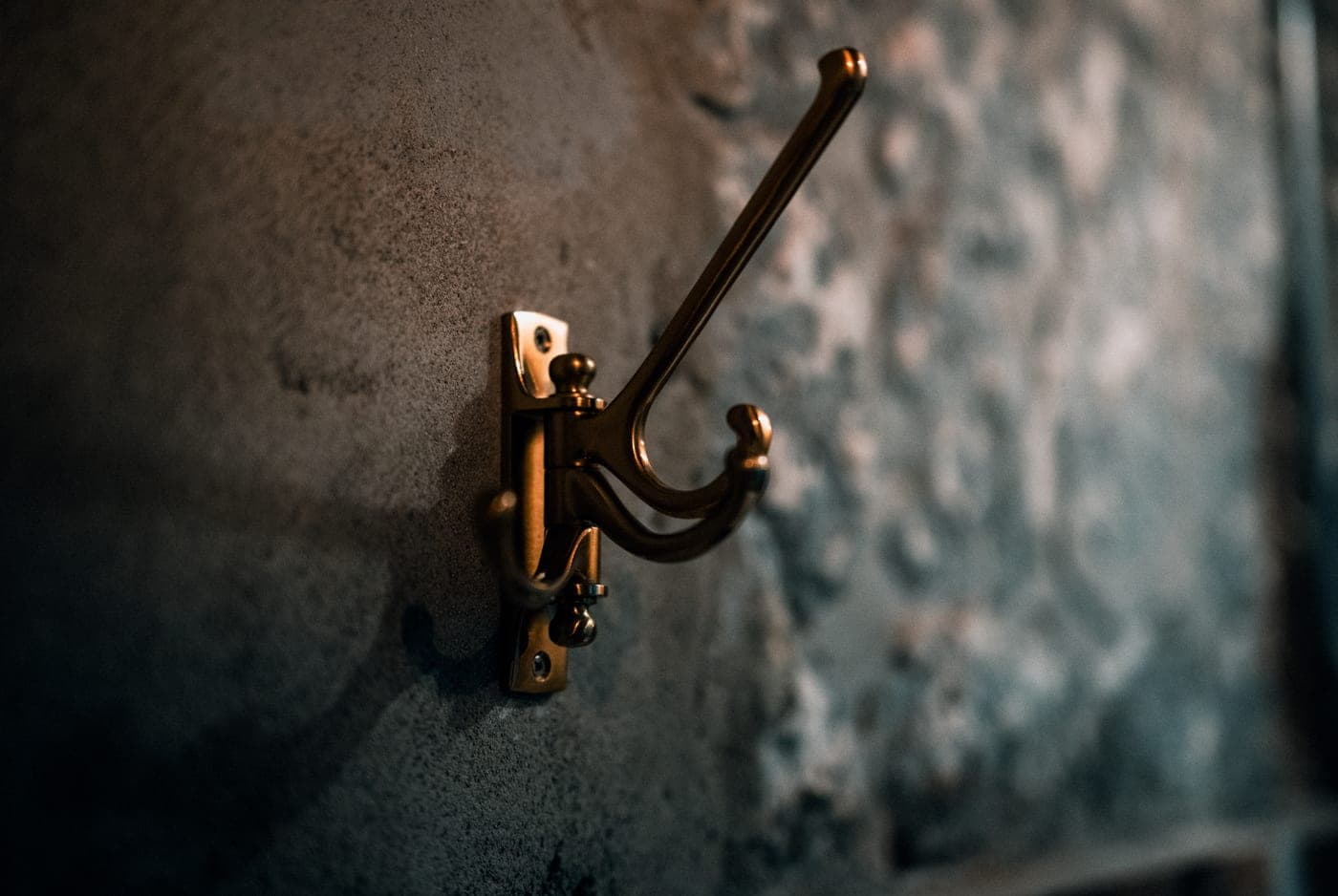
How many hooks does an entryway need?
Two per person, plus two spare. One hook takes the coat someone wears daily and the second takes a bag or a second layer; the spares take visitors and the seasonal coat nobody has put away. For a family of four that is ten, which is what the better hall trees provide.
The reason to plan hooks by person rather than by wall length is that hooks fail by crowding rather than by running out. A coat needs roughly four to five inches of clear width to hang without pressing against its neighbor, and the hall trees we rank space nine hooks across 28 to 39 inches — which is 3 to 4.4 inches apart. On paper that is nine coats. In January it is a compressed wall of wool that nobody can get a single garment out of without moving three others.
So read a published hook count as an upper bound, not a capacity. Nine hooks in two rows, which is the common arrangement, is realistically five coats you can actually reach plus four things that live there permanently — a bag, a dog lead, an umbrella, a spare scarf.
What a hook actually holds
Every hall tree in our registry that publishes a per-hook figure publishes the same one: 11 lb (5 kg). That is the category standard, and it is worth taking literally rather than as a formality.
A dry wool overcoat is roughly 3 to 4 lb. A padded winter parka is heavier. A waxed cotton jacket that has been rained on, with a phone and keys in the pockets, is comfortably over 8 lb, and a soaked canvas backpack with a laptop in it can pass 11 on its own. The rating is a static one — what the hook holds hanging still — and the load spikes well above the resting weight at the moment someone tugs a coat down one-handed on the way out.
The practical rule that follows: hang bags on the hooks nearest a vertical upright, and do not treat a hook rail as somewhere to store the heaviest thing you own. If a loaded rucksack lives by the door every day, it wants a shelf or the floor, not a hook.
Note also what is not published. Of the hall trees we rank, several state a bench load and no per-hook figure at all. An unpublished hook rating is not a claim that the hooks are weak — it is an absence of information, and on a component this cheap to make it is worth reading as one.
Hook height, which is where most entryways go wrong
Published guidance is fairly consistent, and it is the single most useful thing on this page:
Two consequences fall out of that table and both are worth knowing before you buy furniture rather than after.
First, a hall tree's hooks are not adjustable. They sit where the frame puts them, which on the 68 to 72 inch units we rank is somewhere between 55 and 65 inches from the floor. That is correct for adults and wrong for young children by roughly two feet. If children hang their own coats, a hall tree alone will not achieve it, and the fix is a second low rail at 36 to 42 inches rather than a different hall tree.
Second, the same fixed height puts every hall tree hook above the 48-inch accessible reach limit. If anyone in the household uses a wheelchair, hooks have to be mounted separately at a height you choose. This is not a fringe case and no product in this category solves it.
The three shapes that carry hooks
Hooks arrive in an entryway on one of three things, and they are not interchangeable.
- A hall tree. Nine or ten hooks, a seat and about six pairs of shoes from one run of wall 27.6 to 39.4 inches wide and 11.8 to 13.8 inches deep. The most function per wall, the least flexibility on height, and it always has to be screwed to the wall.
- A wall rail above a bench. Takes zero floor depth of its own, you choose the height, and it costs two fixings instead of five. Pair it with a bench and you have a hall tree that fits a narrower corridor and suits any user height.
- A shoe cabinet with hooks built in. Less common and worth knowing about — the 59-inch tall cabinet we rank carries three hooks alongside 24 shoe cubbies, which is enough for today's coats without giving up any pair count.
For most narrow entryways the rail-above-a-bench arrangement is the honest recommendation, and it is worth saying plainly on a page that also ranks hall trees. It is cheaper, shallower, adjustable, and reversible when you move. What you give up is the single integrated object, which is a real thing to want and a reasonable thing to pay for.
The picks in full
Every pick, with the numbers behind it
Top pick
Most entrywaysVASAGLE Hall Tree with Bench, 2 Fabric Drawers and 10 Hooks (UHSR429)
A 220 lb seat, ten rated hooks and under twelve inches of depth — the completest published spec sheet of any hall tree here.
Key dimensions
- Width
- 31.7 in (81 cm)
- Depth
- 11.8 in (30 cm)
- Height
- 71.5 in (182 cm)
- Seat height
- 17.7 in (45 cm)
- Depth band
- Slim
Footprint 31.7 x 11.8 x 71.5 in (81 x 30 x 182 cm). Most shoes flat, larger sizes at an angle.
Full specification
Source: Published 11.8 D x 31.7 W x 71.5 H in, 220 lb seat capacity and 11 lb per hook, VASAGLE UHSR429B01 listing.
What the specs support
- Publishes both a seat rating and a per-hook rating, which most makers do not
- 11.8 in (30 cm) deep is shallow for a piece with a usable seat
- Ten hooks is enough for a family of four in winter
- Fabric drawers come out to be emptied and shaken
Limitations
- 11 lb per hook means a soaked winter coat is close to the limit
- 71.5 in (182 cm) tall — it must be fixed to the wall
- Fabric drawers hold hats and gloves, not muddy boots
Skip this if
You hang heavy wet outerwear. At 11 lb a hook, a waxed jacket carrying rain is at the published limit.
Who it is forA standard entryway that needs coats, shoes and a seat from one 32 in run of wall.
Pick 2
Entries with no mirrorVASAGLE Hall Tree with Mirror and Mesh Shelves (UHSR415)
The widest hall tree here at 38.6 in, with 33 lb mesh shelves and the mirror an entryway usually has to hang separately.
Key dimensions
- Width
- 38.6 in (98 cm)
- Depth
- 13.8 in (35 cm)
- Height
- 70.9 in (180 cm)
- Depth band
- Standard
Footprint 38.6 x 13.8 x 70.9 in (98 x 35 x 180 cm). Adult shoes flat, heel to toe.
Full specification
Source: Published 13.8 D x 38.6 W x 70.9 H in, 11 lb per hook and 33 lb per mesh shelf, VASAGLE UHSR415B01 listing.
What the specs support
- 33 lb per mesh shelf is triple the fabric-drawer models
- Integrated mirror saves a separate fixing and a separate purchase
- Mesh shelves ventilate wet shoes
- 38.6 in of storage width is the most here
Limitations
- 13.8 in (35 cm) is the deepest hall tree in this roundup
- The mirror's own dimensions are not published, so how much of you it shows is unknown until it arrives
- 38.6 in wide plus 13.8 in deep is a serious commitment of hallway
Skip this if
Your hallway is at the 36 in minimum. This is nearly 14 in deep and would leave 22 in of walkway.
Who it is forA wide entry or foyer that currently has no mirror, where a single piece should do coats, shoes and a last look before leaving.
Pick 3
Under 29 inches of wallHOOBRO Hall Tree Entryway Bench with 9 Hooks (BG17MT01)
Twenty-eight and a half inches of bench with nine hooks above it — the smallest complete coat-and-shoe station here.
Key dimensions
- Width
- 28.7 in (73 cm)
- Depth
- 11.8 in (30 cm)
- Height
- 17.5 in (44 cm)
- Seat height
- 17.5 in (44 cm)
- Depth band
- Slim
Footprint 28.7 x 11.8 x 17.5 in (73 x 30 x 44 cm). Most shoes flat, larger sizes at an angle.
Full specification
Source: Published bench 28.7 L x 11.8 W x 17.5 H in with 9 coat hooks and storage for 6 pairs, HOOBRO BG17MT01 listing.
What the specs support
- 28.7 in (73 cm) wide covers coats, shoes and a seat in the smallest span here
- 17.5 in seat height matches the standard exactly
- Nine hooks on a 28 in span is dense coat storage
- 11.8 in deep keeps a 36 in hall usable
Limitations
- 6 pairs of published shoe capacity
- Wall panel dimensions are unpublished, so the finished height is unknown
- Nine hooks across 28 in means coats overlap in practice
Skip this if
Two or more adults use this entry in winter. Nine overlapping hooks on 28 in of wall is a coat pile, not coat storage.
Who it is forA small flat, a landing, or a back door that needs the full hall-tree function in the least possible wall.
Pick 4
Most pairs per square footHOOBRO Tall Shoe Cabinet, 9 Tier (BG24SC01)
Twenty-four cubbies plus a tall compartment stacked into 12.4 in of depth — the best pairs-per-square-foot figure on this site.
Key dimensions
- Width
- 29.5 in (75 cm)
- Depth
- 12.4 in (31 cm)
- Height
- 59 in (150 cm)
- Depth band
- Standard
Footprint 29.5 x 12.4 x 59 in (75 x 31 x 150 cm). Adult shoes flat, heel to toe.
Full specification
Source: Published 29.5 W x 12.4 D x 59 H in, 24 cubes plus 1 large compartment, 3 hooks, 2.2 lb per cube, HOOBRO BG24SC01 listing.
What the specs support
- 24 cubes in 2.5 sq ft of floor is the densest storage here
- 12.4 in (31 cm) of depth takes an adult shoe flat rather than tilted
- The tall compartment is sized for boots the cubes cannot take
- Three hooks turn it into a partial hall tree
Limitations
- 2.2 lb per cube is a shoe, and only a shoe
- At 59 in (150 cm) tall it wants anchoring in a house with children
- Internal cube sizes are unpublished, so a size 13 is a gamble
Skip this if
You wanted somewhere to sit. This is 59 in of vertical storage with no seat at any point.
Who it is forA household with more shoes than wall, where going up is the only direction left.
Fixing hooks that will actually hold
A hook rail carrying five wet coats is holding 30 to 40 lb on two or three fixings, and it applies that load as a downward pull with a leverage component pulling the top of the rail off the wall. Into a stud, that is trivial. Into plasterboard with the plugs that came in the packet, it is the thing that comes off the wall in February taking a plate of plaster with it.
Find the studs, or use a cavity anchor rated for the load rather than a friction plug. Our anchoring guide covers which fixings hold and which fail, and it applies to a hook rail just as much as to a seventy-inch hall tree.
Frequently asked
Questions people actually ask
How many hooks does an entryway need?
Two per person plus two spare — one for a daily coat, one for a bag, and spares for visitors and seasonal layers. For a household of four that is ten, which is what the better hall trees provide.
How much weight can an entryway coat hook hold?
Every hall tree in our registry that publishes a figure states 11 lb (5 kg) per hook. A dry wool coat is 3 to 4 lb; a wet waxed jacket with full pockets can pass 8, and a loaded rucksack can exceed the rating on its own.
How high should coat hooks be?
60 to 65 inches for adults, 66 inches as the builder standard, 54 to 60 inches for a mixed-use entryway, and 36 to 42 inches for children. An accessible hook should be no higher than 48 inches from the floor.
How high should hooks be above a bench?
24 to 30 inches above the seat. On a bench at the 17.5-inch standard that puts the hooks at roughly 42 to 48 inches from the floor — low enough that a hanging coat does not sit on the head of whoever is putting boots on.
Can you adjust the hook height on a hall tree?
No. The hooks sit where the frame puts them, typically 55 to 65 inches up. If children need to reach their own coats, add a separate low rail at 36 to 42 inches rather than looking for a different hall tree.
How far apart should coat hooks be?
About four to five inches of clear width per coat. The hall trees we rank space nine hooks across 28 to 39 inches, which is tighter than that, so treat a published hook count as an upper bound rather than a capacity.
Sources
Where these figures came from
- Coat hook height reference — 60 to 65 in for adults, 66 in builder standard, 36 to 42 in for children, 54 to 60 in in an entryway or mudroom, and 24 to 30 in above a bench seat.
- 2010 ADA Standards for Accessible Design, Section 308 — Unobstructed forward reach range of 15 to 48 in from the finished floor, which caps an accessible hook at 48 in.
- Standard bench seat height — 18 to 19 in from floor to seat top is the residential standard; 18 in (46 cm) for an entryway bench specifically.
- Manufacturer published specifications — Product figures quoted here are the manufacturers' own published dimensions and ratings, cited in full on the roundup this guide links to.
Read next
Where to go from here
Hall trees with storage
Coats, shoes and a seat from one run of wall, ranked on published ratings.
Hall tree dimensions
Standard heights and hook heights, with the ADA reach range that caps them.
Hall tree or coat rack?
When the rail-above-a-bench answer beats the integrated one.
Anchoring entryway furniture safely
Which fixings hold a loaded hook rail, and which pull out of plasterboard.