Guide
Are shoe cabinets worth it?
The pitch is that a cabinet stores three times as many shoes in a third of the floor. That is true, and it is not the whole trade. Here is what the depth actually costs you, and the households that should buy something else.
#ad — We earn a commission from qualifying purchases made through the Amazon links on this page, at no extra cost to you. It does not change what we recommend or the order we rank it in. Full disclosure.
Are shoe cabinets worth it?
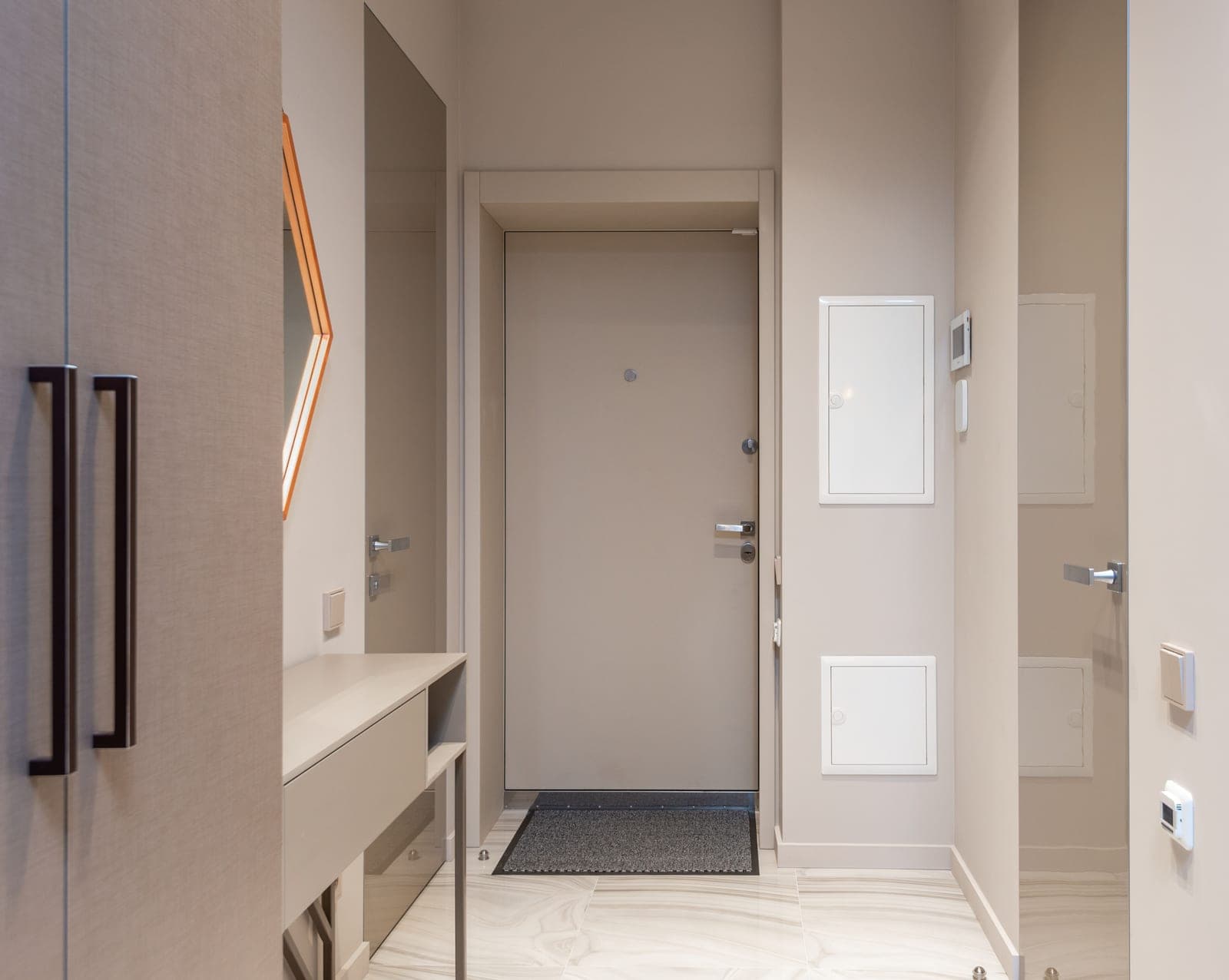
Yes if your problem is pair count in a narrow space, and no if your problem is bulky footwear or somewhere to sit. A narrow cabinet stores 12 to 16 pairs in 9.4 inches of depth — roughly two and a half times a cubby bench's density — but it caps the shoe size it takes, and it gives you nothing to sit on.
This is the question people ask after they have already decided they need shoe storage and before they have decided which kind. It is the right question to ask in that order, because the shoe cabinet is the format with the sharpest trade-offs in the category, and they are not visible in a product photo.
What follows is the arithmetic in both directions. We sell nothing directly; we earn a commission if you buy through a link, and that is exactly why the case against is on the page as fully as the case for.
What you actually get: pairs per square foot
The whole argument for a shoe cabinet is density, and the density is real. Take the four-flip-door cabinet we rank highest: 41.5 inches wide by 9.4 deep, with a stated 16 to 28 pairs. That is 2.71 square feet of floor.
Compare a well-regarded cubby bench of similar width: 41.3 inches by 11.8 deep, 8 to 10 pairs. That is 3.38 square feet for 10 pairs. At the top of its stated range the cabinet holds nearly three times as many shoes on a fifth less floor; even at the bottom of it, sixty per cent more.
Go vertical and the gap widens further. A nine-tier tower at 29.5 by 12.4 inches publishes 24 cubes plus a large compartment on 2.54 square feet. Nothing else in entryway furniture approaches that, and if the problem you are solving is genuinely a pile of shoes, no other format is close.
Treat the absolute numbers as an upper bound and the ratios as the real finding. Whatever a maker's stated capacity is worth, a cabinet beats a cubby bench by roughly two to four times on the same floor — and our shoe storage capacity guide covers how much to discount the headline figure.
What it costs you, in numbers
Three things, and the first is the one that catches people.
Shoe size
A slim cabinet is 9.4 inches deep. No adult shoe lies flat in that, so shoes stand tilted on edge inside a flip drawer, sole against the back panel. That works comfortably for a women's average foot of about 9.8 inches and steeply for a men's average of 10.8. At a men's 13, around 12 inches of foot, the shoe sits at a sharp angle and the drawer front can catch on it. The depth that creates the density is the same depth that creates the ceiling — you cannot have one without the other. The full arithmetic is on our shoe cabinet depth page.
Drying
A closed cabinet traps the moisture wet shoes bring in, and that moisture is what causes the smell. It is a solvable problem — louvered doors exist, and so does leaving a door ajar on a wet day — but it is a problem the open formats simply do not have. Our ventilation guide is the page on this.
Somewhere to sit
A cabinet gives you nothing to sit on, and putting shoes on standing up is how shoes end up by the door rather than in the storage you bought. Some cabinets offer a top surface instead, and the published top loads vary enormously: 121 lb on one wide cabinet, 44 lb on a narrow one, 22 lb on a slim three-drawer and 15 lb on another. That is the difference between a surface and a shelf, and it is worth reading before you plan a lamp onto it.
The three households a shoe cabinet is wrong for
Said plainly, because the honest answer to "is it worth it" is sometimes no.
- Boots, work boots or chunky high-tops are the daily footwear. A flip drawer is defeated by height as much as by length, and a household in boots will find half the cabinet unusable. Our boots and tall shoes guide has the formats that do work.
- Someone needs to sit down to put shoes on. A child, an older relative, anyone with balance or mobility limits — for them the seat is not a luxury feature, it is the point of the furniture, and a cabinet does not provide one.
- Shoes routinely come in wet, and the entry has no ventilation. A sealed box of damp shoes by a front door is a smell problem you will be managing rather than a storage problem you have solved.
None of those three is a criticism of any particular cabinet. They are cases where the format itself is the wrong tool, and no amount of paying more fixes it.
The case where it is obviously worth it
A narrow hallway with more pairs than floor. That is the scenario the format was designed around and it wins it decisively.
In a hall at the 36-inch residential code minimum, a 9.4-inch cabinet leaves 26.6 inches of walkway. A 11.8-inch bench leaves 24.2, and 24 inches is roughly where two people stop being able to pass each other. The cabinet stores two to three times as many shoes AND leaves the hall more usable, which is a rare case of a trade that only goes one way. Our narrow entryway widths page has the walkway figures.
The second clear case is a household with a lot of flat shoes — trainers, pumps, sandals, school shoes. The shoe-size ceiling never binds, the density is fully realized, and the objection that defeats the format for boot households simply does not arise.
The picks in full
Every pick, with the numbers behind it
Top pick
A low console under a mirrorVASAGLE Shoe Cabinet with 4 Flip Doors (ULBC035)
Low, wide and 9.4 in deep with a 121 lb top — the only slim cabinet here strong enough to be furniture as well as storage.
Key dimensions
- Width
- 41.5 in (105 cm)
- Depth
- 9.4 in (24 cm)
- Height
- 32.6 in (83 cm)
- Depth band
- Ultra-slim
Footprint 41.5 x 9.4 x 32.6 in (105 x 24 x 83 cm). Tilted or on-edge storage only.
Full specification
Source: Published 9.4 D x 41.5 W x 32.6 H in, 16-28 pairs, 121 lb top / 13 lb per flip drawer, VASAGLE ULBC035B01 listing.
What the specs support
- 121 lb top rating is five times the slim cabinet — a genuine console surface
- 32.6 in (83 cm) high leaves wall clear for a mirror or hooks above
- 9.4 in (24 cm) deep despite 28 pairs of stated capacity
- Low and wide is far more stable than tall and narrow
Limitations
- 41.5 in (105 cm) needs a long wall
- Shoes sit on edge at this depth, which is hard on soft leather
- 13 lb per flip door
Skip this if
Wall length is your constraint rather than depth. There are 23 in wide cabinets here that hold nearly as many pairs.
Who it is forA hallway with a long uninterrupted wall, where the cabinet doubles as the console table under the mirror.
Pick 2
Halls under 40 inchesHOOBRO Narrow Shoe Cabinet with 2 Flip Drawers (WT21SC01)
Nine and a half inches deep with two flip drawers and shelves that move to three heights — the cabinet for a hall that cannot spare a foot.
Key dimensions
- Width
- 31.5 in (80 cm)
- Depth
- 9.4 in (24 cm)
- Height
- 40.5 in (103 cm)
- Depth band
- Ultra-slim
Footprint 31.5 x 9.4 x 40.5 in (80 x 24 x 103 cm). Tilted or on-edge storage only.
Full specification
Source: Published 9.4 D x 31.5 W x 40.5 H in, 12-16 pairs, 44 lb top / 22 lb per internal shelf, 42.8 lb product weight, HOOBRO WT21SC01 listing.
What the specs support
- 9.4 in (24 cm) deep leaves 26 in of walking room in a code-minimum 36 in hall
- Three shelf heights is the most adjustment of any cabinet here
- 44 lb top rating means it can hold keys, post and a lamp, not just look flat
- Open bottom shelf for the pair you are actually wearing today
Limitations
- At 9.4 in deep shoes sit tilted, so a men's 12 is at the edge of what fits
- 42.8 lb is heavy for a wall-adjacent cabinet you may want to move
- Flip drawers hold shoes on edge, which crushes soft uppers over time
Skip this if
The household wears size 12 or larger. At this depth large shoes sit at a steep angle and the drawer front fouls.
Who it is forA genuinely narrow hall, corridor or apartment entry where a 12 in cabinet would make the walkway unusable.
Pick 3
Most pairs per square footHOOBRO Tall Shoe Cabinet, 9 Tier (BG24SC01)
Twenty-four cubbies plus a tall compartment stacked into 12.4 in of depth — the best pairs-per-square-foot figure on this site.
Key dimensions
- Width
- 29.5 in (75 cm)
- Depth
- 12.4 in (31 cm)
- Height
- 59 in (150 cm)
- Depth band
- Standard
Footprint 29.5 x 12.4 x 59 in (75 x 31 x 150 cm). Adult shoes flat, heel to toe.
Full specification
Source: Published 29.5 W x 12.4 D x 59 H in, 24 cubes plus 1 large compartment, 3 hooks, 2.2 lb per cube, HOOBRO BG24SC01 listing.
What the specs support
- 24 cubes in 2.5 sq ft of floor is the densest storage here
- 12.4 in (31 cm) of depth takes an adult shoe flat rather than tilted
- The tall compartment is sized for boots the cubes cannot take
- Three hooks turn it into a partial hall tree
Limitations
- 2.2 lb per cube is a shoe, and only a shoe
- At 59 in (150 cm) tall it wants anchoring in a house with children
- Internal cube sizes are unpublished, so a size 13 is a gamble
Skip this if
You wanted somewhere to sit. This is 59 in of vertical storage with no seat at any point.
Who it is forA household with more shoes than wall, where going up is the only direction left.
Pick 4
The narrowest footprintVASAGLE Slim Shoe Storage Cabinet, 3 Flip Drawers
Twenty-three inches of wall and nine and a half of depth for up to twenty pairs — the smallest floor footprint on this site.
Key dimensions
- Width
- 23.6 in (60 cm)
- Depth
- 9.5 in (24 cm)
- Height
- 47.7 in (121 cm)
- Depth band
- Ultra-slim
Footprint 23.6 x 9.5 x 47.7 in (60 x 24 x 121 cm). Tilted or on-edge storage only.
Full specification
Source: Published 9.5 D x 23.6 W x 47.7 H in, 12-20 pairs, 22 lb top / 11 lb per flip drawer, VASAGLE slim shoe cabinet listing.
What the specs support
- 1.6 sq ft of floor for up to 20 pairs is the best ratio here
- 23.6 in (60 cm) wide fits beside a door without blocking the swing
- Adjustable dividers let one drawer take boots and another take flats
- Closed fronts keep an entry looking tidy from the next room
Limitations
- 22 lb top rating is the lowest here — a lamp and keys, nothing more
- 11 lb per drawer
- 47.7 in tall on a 9.5 in base is top-heavy and wants anchoring
Skip this if
You need a surface as much as storage. A 22 lb top will not take a heavy bowl, a plant or a stack of parcels.
Who it is forA tight apartment entry where the wall beside the door is all there is, and the shoes need to be out of sight.
Pick 5
Most entrywaysVASAGLE Shoe Bench with Cushion, 15 Compartments (ULHS15)
The one bench here that gives you a real seat, a 440 lb rating and fifteen adjustable compartments without going deeper than a foot.
Key dimensions
- Width
- 41.3 in (105 cm)
- Depth
- 11.8 in (30 cm)
- Height
- 18.9 in (48 cm)
- Seat height
- 18.9 in (48 cm)
- Depth band
- Slim
Footprint 41.3 x 11.8 x 18.9 in (105 x 30 x 48 cm). Most shoes flat, larger sizes at an angle.
Full specification
Source: Published dimensions and 440 lb load rating, VASAGLE ULHS15WT / ULHS15BR listing.
What the specs support
- 440 lb rating is the highest of any bench here, and it is published rather than implied
- 11.8 in (30 cm) deep, so it clears a 36 in hallway with the door swing intact
- Adjustable shelves mean boots and sneakers can share the same carcass
- The cushion cover unzips, which matters on the one surface in the house that meets wet shoes
Limitations
- 41.3 in (105 cm) is a lot of wall for a small entry
- Compartment internal depth is not published, so tall boots are a gamble
- 12 mm particleboard is the category norm, not an upgrade
Skip this if
You have less than 44 in (112 cm) of clear wall. At 41.3 in wide this bench needs the whole run, and there is a narrower option below that gives up only a few pairs.
Who it is forA family entry with a full wall to give it, where the bench has to take an adult sitting down to pull boots off every day.
What to buy instead, if the answer is no
If it is the seat you need, buy a bench and accept the density penalty. A cubby bench at 11.8 inches deep gives you a seat, open compartments that dry, and roughly a third of the pair count. That is the honest trade and our bench roundup ranks them.
If it is coats as well as shoes, buy a hall tree. One run of wall, three problems, and the comparison between the two formats is on our hall tree versus shoe cabinet page.
If it is boots specifically, buy the one cabinet format that handles them: an open-compartment model or one with genuinely adjustable shelf heights, so the pitch can be set for the footwear you own rather than the footwear the factory assumed.
And if you are furnishing an entry from nothing, the order matters more than the format — our first entryway setup guide argues that the bench goes first and the pair count is stage three.
Frequently asked
Questions people actually ask
Are shoe cabinets worth it?
For a narrow hall with more pairs than floor, decisively yes — roughly three times the density of a bench in less depth. For a household in boots, or one that needs somewhere to sit, no.
Do shoe cabinets hold as many pairs as they claim?
Treat the stated figure as an upper bound measured with smaller shoes. The ratios between formats hold up even when the absolute numbers do not, because every maker overstates the same way.
Will a men's size 13 fit in a slim shoe cabinet?
It will go in but sit at a sharp angle in a 9.4-inch cabinet, and the drawer front can catch on it. Makers rarely publish internal drawer geometry, so the exact cut-off is not knowable from a listing.
Do shoe cabinets make shoes smell?
A sealed cabinet traps the moisture that causes the smell. Louvered or vented doors fix it; so does leaving a door ajar after a wet day. Open shelving does not have the problem at all.
Can you sit on a shoe cabinet?
No. Published top loads on the cabinets we rank run from 15 to 121 lb — enough for a lamp and a bowl of keys, nowhere near a person. If you need a seat, buy a bench.
Is a shoe cabinet or a bench better?
A cabinet for pair count in minimum depth; a bench for a seat and for drying. In a 36-inch hallway the cabinet also leaves about 2.4 more inches of walkway, which is the margin that decides whether two people can pass.
Sources
Where these figures came from
- US shoe size to foot length charts — Foot length in inches by US women's and men's size, plus the published conversion formulas (women's = 3L - 21, men's = 3L - 22). Used for every depth calculation on this site.
- Average US shoe size, women — Reported average of US women's 8.5 to 9.
- Average US shoe size, men — Reported average of US men's 10 to 11.
- International Residential Code minimum hallway width — 36 in minimum for a residential hallway; 36 to 42 in typical, 42 to 48 in comfortable.
- Manufacturer published specifications — Every footprint, stated capacity and top-load figure quoted on this page is the manufacturer's own published number for a product in our registry. The pairs-per-square-foot column is arithmetic on those published figures, not a measurement of our own.
Read next
Where to go from here
All shoe storage cabinets
The full roundup, if the answer turned out to be yes.
Shoe cabinet or bench?
The same decision, resolved on floor area rather than on doubt.
Shoe cabinet depth, resolved
The shoe-length arithmetic behind the size ceiling.
Does a shoe cabinet need ventilation?
The drying problem, and the door designs that solve it.
Is a hall tree worth it?
The same honest arithmetic, for the format that also takes coats.